← Blog
 Eugene Arutyunov
Every Conversation Leaves a Fingerprint
The Velma conversation fingerprint is the house data visualization for conversations — the signature mark of the design language. Wherever a conversation shows up — in the product, in a report, in a demo — it leaves the same recognizable picture. Here it is in its fullest form, paired with the player:
Anatomy
The fingerprint is one component that flexes within fixed ranges. Every picture in this post is the same component — only the settings differ.
The X axis is a timeline that operates on fragments of speech — clips — rather than raw audio. The Y axis discretely splits the picture by speaker, one lane per voice. The standard encoding is color for detected emotions and a glyph for detected behaviors.
The information dial
How much a fingerprint tells is a dial. Bare clips only mark who spoke and when:
Detected emotions add color, and detected behaviors add a glyph on top:
One lane per voice
The number of speakers is 1, 2 or N. A single speaker reads as one strip:
A full room splits the same height into lanes:
Color is emotion
Clips are painted with the detected emotion. The colors come straight from the design system — one color per emotion in the model's vocabulary:
emotion-angry
emotion-disgusted
emotion-afraid
emotion-surprised
emotion-happy
emotion-sad
emotion-neutral
emotion-other
emotion-unknown
Every scale
The fingerprint speaks the same language at every size — that is what makes it an asset rather than a chart.
Icon scale
At the smallest scale the language compresses to a few bars. These are actual design-system icons:
Miniatures
Between the icon and the full view live miniatures — fingerprints in a table row, next to the conversations they belong to:
| Fingerprint | Conversation |
|---|
Or a plain flow of conversations, wrapping like text:
Full view
The ladder tops out at the full view — and there the fingerprint can also stand alone, as pure data, without the player chrome this post opened with:
Lanes beyond speakers
The Y axis can be rethought: lanes can be technologies instead of speakers. Here the same call is analyzed by two engines, one lane each, each with its own transcript variant. A clip that carries a signal blooms its color into the lane; a glyph with a count aggregates several signals:
The comparison can also isolate one selected signal: every flagged clip gets the same one-step highlight, and the glyph tells the case — a catch, or a red-marked false positive:
In the wild
The format scales past illustrations: the fingerprint can anchor a whole animated demo widget. Below, the same player drives Velma's fraud-call demo — the transcript, the signal feed and the risk meter all run off the timeline. Click anywhere on the plate to play:
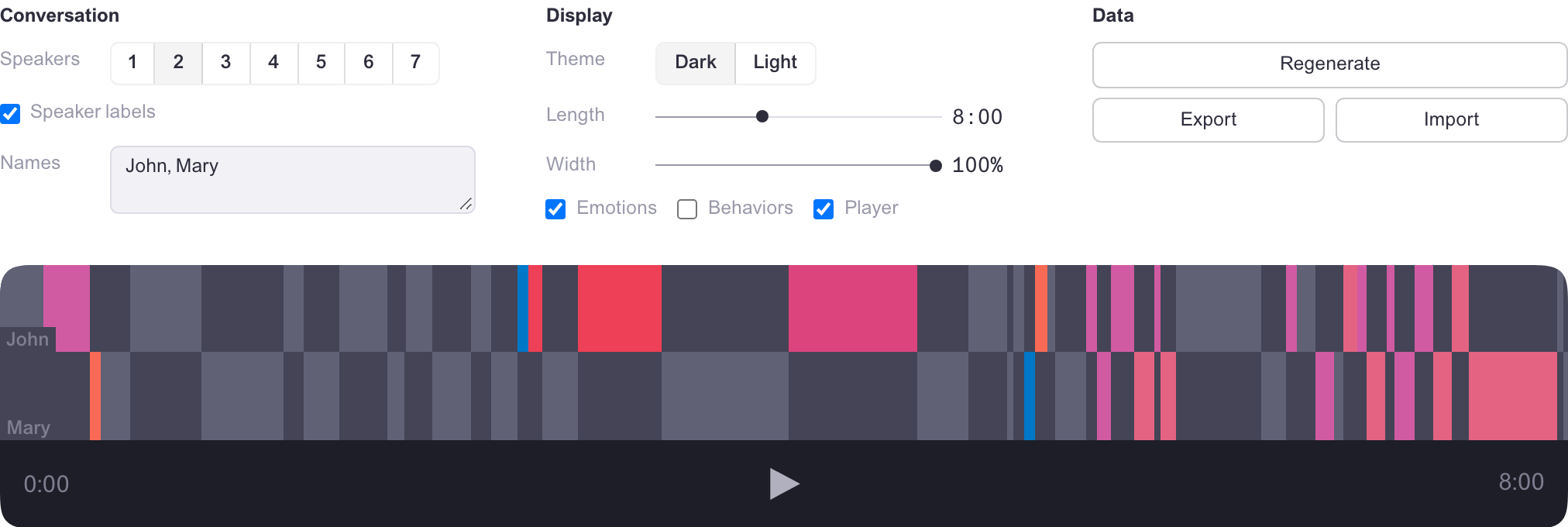
Everything in this post is generated — every picture is the same renderer with different settings. The playground has the dials: set the room, flip the switches, export the result as data, or import a real conversation.
Try it: Velma Conversation Fingerprint.